Navigating the Hilar Dilemma: When Cholangioscopy Rewrites the Staging
MRCP said Klatskin IIIa. The mucosa said otherwise.
Lire le cas →← Cas cliniques · ERCP
A guidewire slipped. The new trajectory looked pancreatic. It was a low biliary confluence.
An emergent ERCP in an 87-year-old woman with Grade 3 acute cholangitis yielded a crucial anatomical insight following an unexpected procedural pivot.
During a routine balloon sweep, the guidewire slipped out. The recannulation attempt took an unusual lateral trajectory, initially raising suspicion for pancreatic duct entry. Contrast injection under fluoroscopy ruled out PD side branches and confirmed a short 2 cm common bile duct splitting into two low-confluence parallel hepatic ducts.
With a mobile stone in the left duct, partial drainage carried a high risk of cross-occluding the adjacent right orifice or leaving an infected liver sector isolated. To secure complete source control in severe sepsis, parallel stents were placed in both ducts.
Contenu destiné aux médecins et professionnels de santé. Données anonymisées ; ce cas ne constitue pas une recommandation de prise en charge individuelle.
 ▶ 6:51
MRCP said Klatskin IIIa. The mucosa said otherwise.
Lire le cas →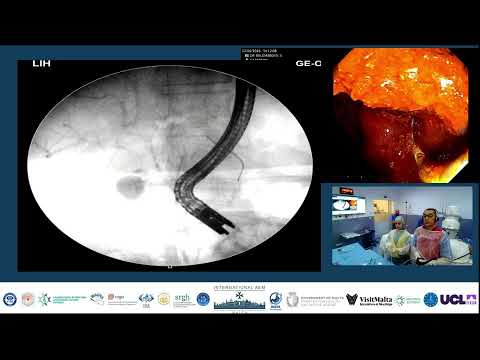 ▶ 3:38
Pus came out spontaneously, under pressure. That was the moment not to inject.
Lire le cas → ▶ 0:53
Finesse, not force. The endoscopist conducts; the nurse deploys.
Lire le cas →