An Anatomical Pitfall Avoided: When Wire Loss Uncovers a 2 cm CBD in Grade 3 Cholangitis
A guidewire slipped. The new trajectory looked pancreatic. It was a low biliary confluence.
Lire le cas →← Cas cliniques · ERCP
MRCP said Klatskin IIIa. The mucosa said otherwise.
Radiology can sometimes paint a definitive, alarming picture. A 61-year-old patient presented with intense jaundice, and the MRCP strongly suggested a Bismuth-Corlette type IIIa Klatskin tumor — a 15 mm common hepatic duct stricture with dilated left and right hepatic ducts and parenchymal edema.
Direct digital cholangioscopy revealed a completely normal, clean mucosa with no signs of infiltration.
Cross-sectional imaging and cholangiograms frequently struggle to differentiate malignant hilar cholangiocarcinoma from benign inflammatory strictures. Treating the imaging rather than the true mucosal anatomy risks unnecessary radical interventions.
Pruritus resolved within 48 hours, with rapid clearance of jaundice and an uneventful recovery. Direct visualization, favorable tactile feedback and negative biopsies corrected the diagnostic trajectory.
Access the proximal ducts properly and a complex hilar bottleneck becomes a manageable mechanical problem.
Contenu destiné aux médecins et professionnels de santé. Données anonymisées ; ce cas ne constitue pas une recommandation de prise en charge individuelle.
 ▶ 1:09
A guidewire slipped. The new trajectory looked pancreatic. It was a low biliary confluence.
Lire le cas →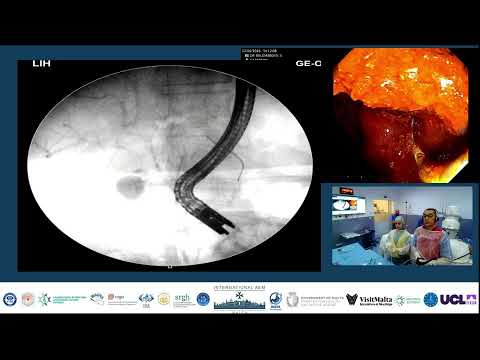 ▶ 3:38
Pus came out spontaneously, under pressure. That was the moment not to inject.
Lire le cas → ▶ 0:53
Finesse, not force. The endoscopist conducts; the nurse deploys.
Lire le cas →