An Anatomical Pitfall Avoided: When Wire Loss Uncovers a 2 cm CBD in Grade 3 Cholangitis
A guidewire slipped. The new trajectory looked pancreatic. It was a low biliary confluence.
Lire le cas →← Cas cliniques · ERCP
Finesse, not force. The endoscopist conducts; the nurse deploys.
The endoscopist and the nurse must act as a single unit. The nurse becomes the active assistant controlling the deployment mechanism, while the endoscopist focuses on scope position, stability and fluoroscopic guidance.
A successful two-person SEMS release transforms a potentially stressful moment into a controlled, predictable maneuver.
Endoscopist: "Scope is stable in long position. Stent 2 cm above the stricture. Ready?"
Nurse: "Ready. Handle unlocked."
Endoscopist: "Begin deployment, nice and slow… good pace… the top is starting to flare… stop. Position ideal. Continue, same pace."
Nurse: "Stent is free."
When this teamwork clicks, it is one of the most satisfying experiences in the endoscopy suite.
Contenu destiné aux médecins et professionnels de santé. Données anonymisées ; ce cas ne constitue pas une recommandation de prise en charge individuelle.
 ▶ 1:09
A guidewire slipped. The new trajectory looked pancreatic. It was a low biliary confluence.
Lire le cas → ▶ 6:51
MRCP said Klatskin IIIa. The mucosa said otherwise.
Lire le cas →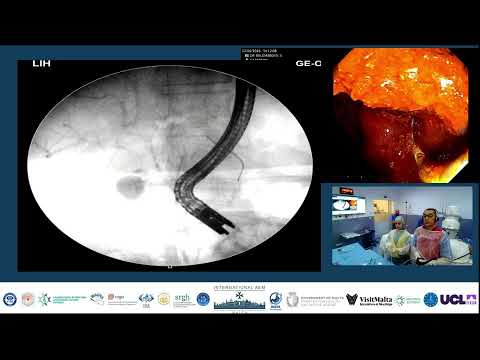 ▶ 3:38
Pus came out spontaneously, under pressure. That was the moment not to inject.
Lire le cas →